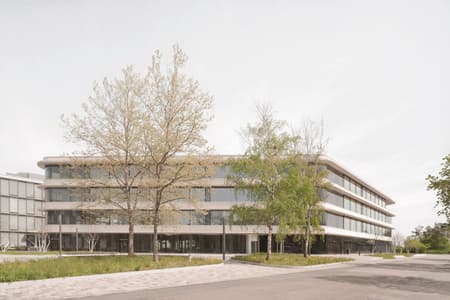
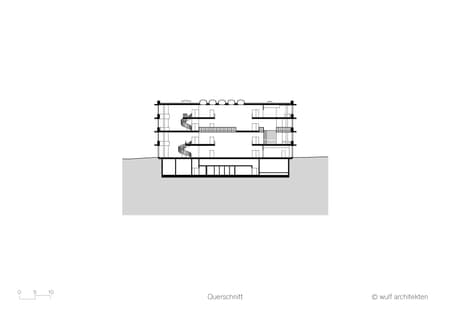
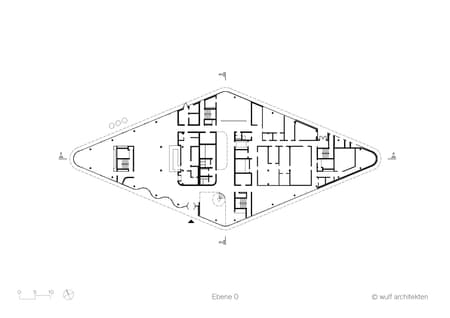
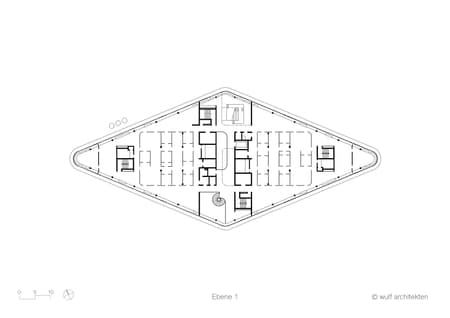
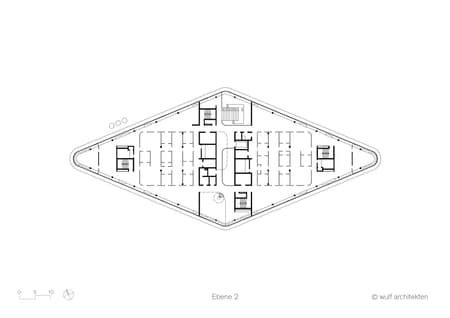
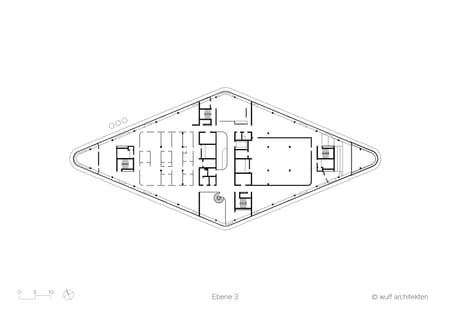
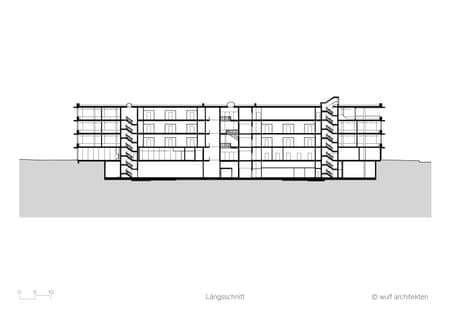
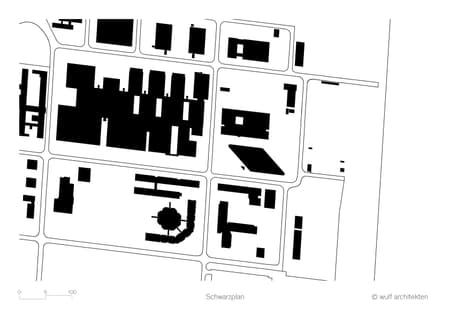
The Helmholtz Pioneer Campus, a new laboratory and office building in Neuherberg on the outskirts of Munich, provides a state-of-the-art workplace tailored to the specific needs of international scientists. The researchers work for limited periods of five to seven years in so-called »pioneer groups« in the fields of biomedicine, bioengineering, and biomedical AI. The Helmholtz Pioneer Campus promotes interdisciplinary collaboration, and its internal organization, which anticipates the structural framework of a campus, encourages formal and informal communication..
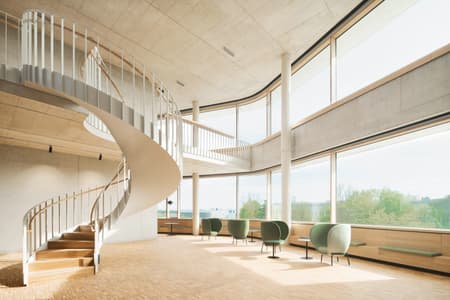
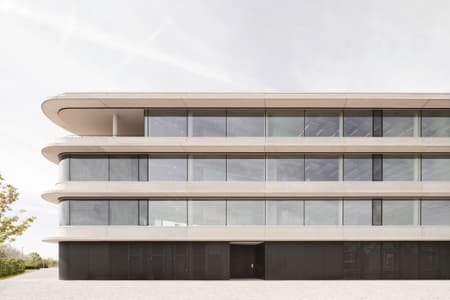
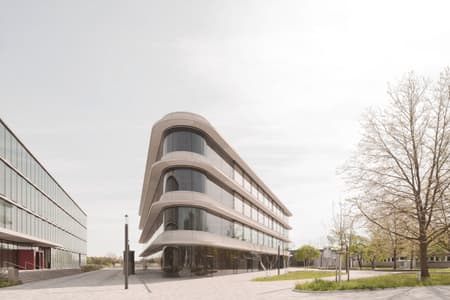
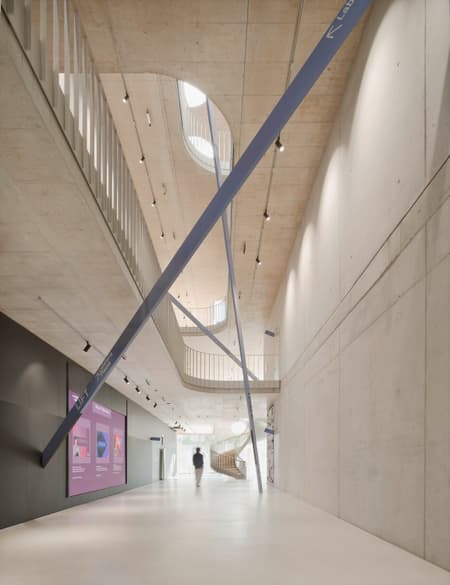
The reinforced concrete frame building in the distinctive shape of a rhombus takes up a self-confident position within the uniform orthogonal structure of the Helmholtz Center and sets a clear architectural accent on the newly created Gaborplatz. The overall building configuration is based on two symmetrically arranged, self-contained laboratory modules, flanked on three sides by office zones of variable design. At the center is a spacious atrium that integrates communication and work areas, allowing the facilities to be freely arranged on different floor levels. The atrium area enables scientists from different »pioneer groups« to communicate and conduct research in varying constellations and spatial situations.
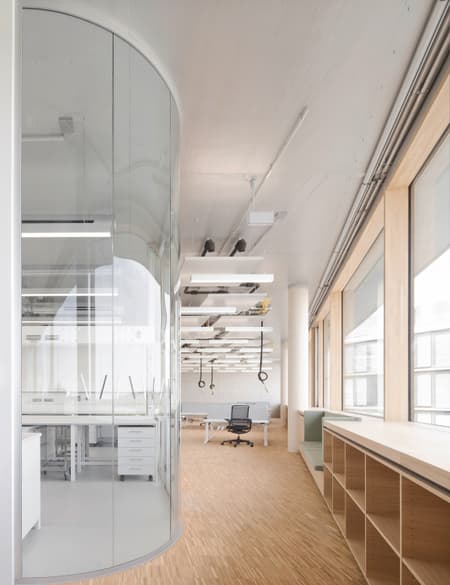
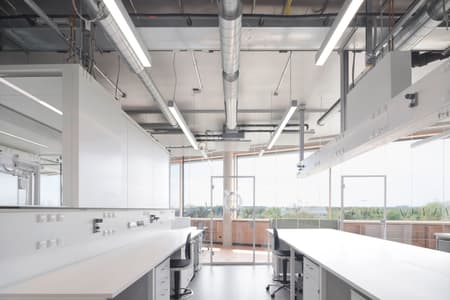
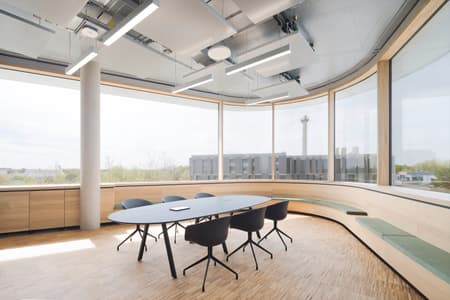
Users have access to flexibly furnishable conference rooms and areas for informal work and presentations at the tapered ends of the building. Between them and the atrium, flex zones provide a highly configurable transition area with laboratory and office spaces. The laboratories can be partitioned off as needed with boxes that can be assembled and disassembled like lab furniture.
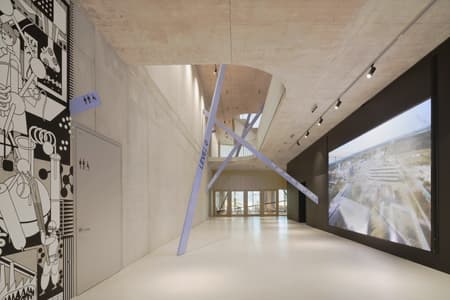
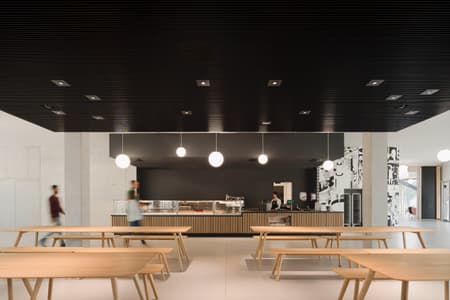
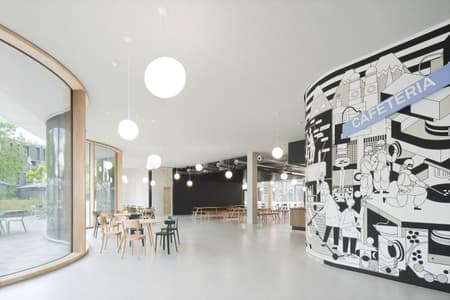
Terrazzo flooring on the ground floor dominates as a continuous element in the cafeteria and “piazza” areas, while the continuous wood flooring on the upper floors provides a deliberate contrast. Furniture specially selected and fabricated for the project, such as the built-in cabinets and sideboards along the facade that double as seating or tables, is also predominantly made of wood. The large black and white mural by Shiwen Sven Wang sets the mood for visitors as soon as they enter the building. The unusual orientation system guides the researchers through all levels of the building: nine ribbons, each up to 18 meters long, are mounted diagonally in the atrium between the research laboratories and stretched like rubber bands between the floor, walls, and ceilings. Taken together, these directional bands form a sculpture that not only points the way, but also communicates the building’s identity.