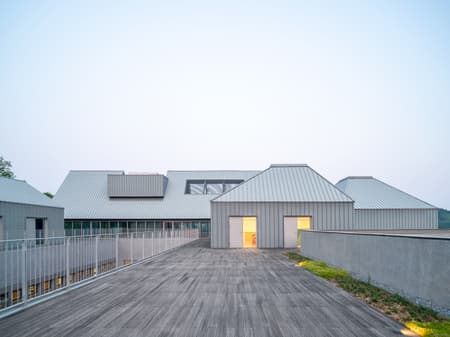
7hills Yard is situated within a village adjacent to the Moganshan Town Tourist Distribution Center. It borders Huangfu East Road, lined with lush plane trees, to the north, while its other sides face a picturesque and lively rural settlement. The site originally contained a rural factory and a nursery garden, intersected by a village path. The new design preserves this path within the site boundary while integrating the two plots into a cohesive whole through connected second and third levels.
The building's ground floor and top-floor volumes are set back from the street, creating spaces under the eaves and open-air terraces, while the nearly hundred-meter-long second-floor façade is concealed behind the canopy of phoenix trees. This elevation detaches from the ground, appearing to float in mid-air. Such an approach allows passersby to perceive both the continuity of the street and a softened presence, avoiding the oppressive feeling of a large building. On the village side, the second-floor volume winds along the site's boundary, seamlessly integrating into the surrounding residential fabric. The parapet height of the second-floor roof is controlled to around 10 meters, consistent with traditional eaves-height regulations in rural settlements. Although the building's volume, driven by public program requirements, is many times larger than typical village houses, its controlled height ensures that villagers walking on the village side seldom perceive it as an overwhelmingly massive structure. Only occasionally, through gaps in the village lanes, do they glimpse a horizontally extended platform suspended in the air. On the dark rooftop terrace, seven small metal-roofed houses are scattered, their scale and spacing reminiscent of neighboring village clusters. When viewed from buildings across the street, this elevated village-like image appears as a new continuation of the rural landscape.
Yucun Village in Moganshan Township is a rural area reshaped by a globalized perspective, where local production and daily life are deeply embedded within global networks. Traditional agricultural practices are being replaced by more diverse economic activities while simultaneously incorporating highly industrialized and impersonal modes of agricultural production. The relationships between villagers and the land, between villagers and tourists, and between villagers and new residents are undergoing significant transformations. Consequently, Yucun presents itself as a complex and diverse village—a juxtaposition of old and new, intertwining regional traditions with the spirit of the times. In terms of spatial programming, Qifeng Courtyard is conceived as a new type of public service space. It integrates composite functions such as office incubation, product exhibition and sales, skills training, and social interaction. This spatial product is designed for industrial users of varying scales and serves as a testing ground for exploring new modes of rural production, lifestyles, and economic models.
On the ground floor of the building, solid and void masses are arranged alternately, allowing the architecture to blend into the surrounding village fabric. Public activities from the streets and the village naturally flow into the interior. Functions facing the street include commercial and exhibition spaces, while areas closer to the village accommodate internally used amenities such as dining, tea breaks, and parcel handling.
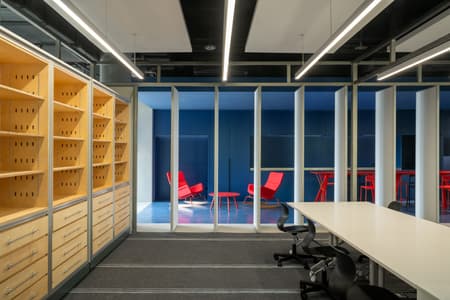
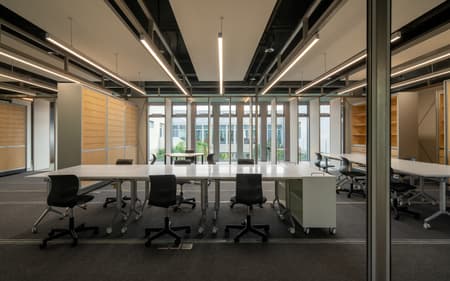
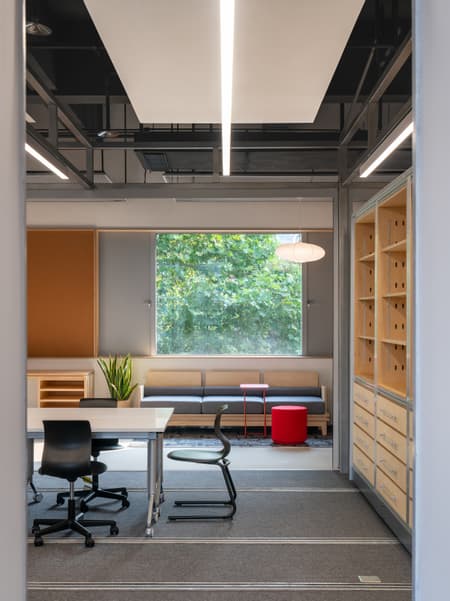
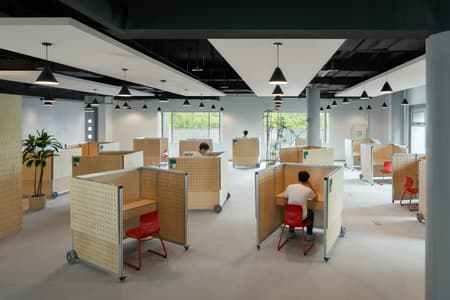
The second-floor plan resembles a miniature city, where diverse textures accommodate various office layouts. Circulation around the courtyard openly and compatibly links spaces of different forms. During the initial design phase, only spatial programming and the designers were involved. As actual users could not be predetermined, we adopted a product design logic in the spatial design. Based on different usage needs, we integrated the design of hard and soft furnishings into various systematic elements such as tables, chairs, storage, tea stations, printing areas, bulletin boards, and partitions. Different work scenarios were created through the categorized arrangement of fully integrated systems, station-based systems, and adaptable systems. Among these, fixed studios provide office spaces for long-term teams; creative warehouses offer flexible possibilities for teams with periodically changing small units; inspiration camps provide maximum flexibility for separable and combinable work modes; and individual workstations represent the smallest enclosed and fixed units.
The top floor is designed as a standalone studio area. Each studio can be accessed directly via an individual staircase from the ground floor or reached through the public atrium, leading to the shared terrace before entering. Standing on the 3,000-square-meter shared terrace, one can take in the surrounding views—gazing into the distance at the century-old architectural clusters on the mountain and looking down at the vibrant daily life at its foothills. Qifeng Courtyard offers Yucun Village a fresh public perspective to observe the surrounding landscape.
In the building's plan layout, two courtyards are used to address its significant depth: one courtyard is paved with hardscape to accommodate future outdoor activities, while the other remains vegetated, also incorporating the existing village path. In the building's section design, two atriums facilitate visual and light connections across different floors: one atrium houses the main elevator lobby and a ceremonial staircase, illuminated by diffused light from the top floor and side openings on the ground floor; the other atrium links the second-floor roadshow space with the third-floor library, with its ceremonially designed top lighting providing upward visual guidance for the expansive second-floor layout. Both atriums create richer and more diverse opportunities for public interaction within a compact scale.
Mobility (Flexible and Transformable Furniture Modules)
Mobility is an intriguing and romantic concept. It may appear aimless, idle, or even frivolous on the surface, yet in unexpected situations, it can play a remarkably significant role. Translating this concept into the realm of space means that objects can move—traveling from point A to point B, yet also pausing wherever and whenever needed. At the level of objects, it refers to the smallest functional units capable of transforming their forms and expanding their uses to adapt to different scenarios, much like a Swiss Army knife, where each small tool addresses various everyday tasks. These flexible and transformable furniture modules embody the spatial strategy envisioned by Archizoom Associati in their No-Stop City model—an infinitely continuous, universally neutral, and user-self-organized environment.
The Alien Element at the Town Entrance (Massing and Facade Materials)
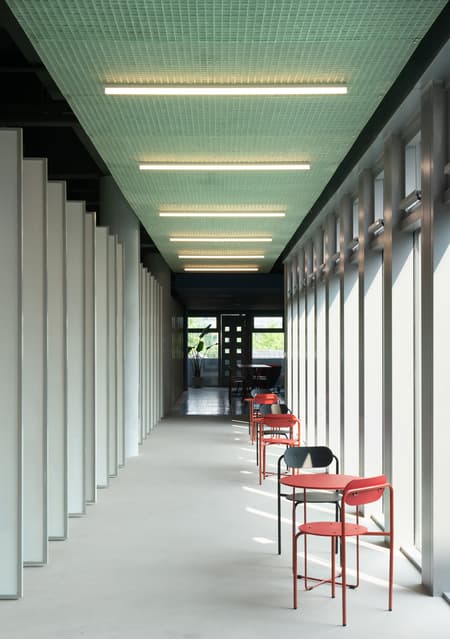
Qifeng Courtyard is situated at the entrance to the dense town area at the foot of the mountain. The facade of its large second-floor volume is clad in grey washed stone, punctuated by sections of silver-grey metal panels. The overall atmosphere emphasizes the warmth and texture of handcrafted materials while incorporating industrial elements that ensure structural performance. The facade designs facing the street and the village respond to internal functional needs, utilizing elements such as large fixed glazing, operable metal panels, cantilevered balconies, recessed balconies, and integrated terrace railings to harmonize the rhythm and appearance of the facade, creating a clean and elegant silhouette. The facades of the internal courtyards, on the other hand, are defined by low-hanging perforated metal ceilings, floor-to-ceiling glass divisions, metal railings, and partially protruding terraces, shaping two courtyards with distinctly different atmospheres—one dynamic and the other tranquil.